

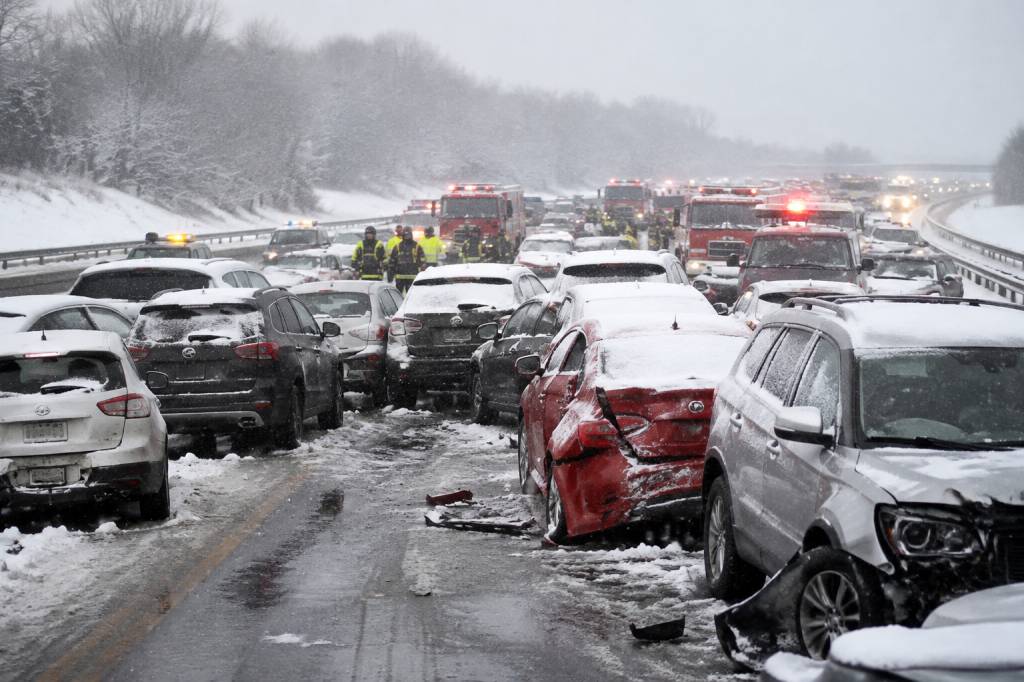
A “100-car pileup” sounds like one crash involving a hundred vehicles at once. In reality, it is usually a chain of collisions that grows over minutes as drivers encounter a hazard they cannot see, cannot avoid, or do not have enough room to respond to. Fog, smoke, blowing snow, icy pavement and sudden traffic slowdowns can combine to turn an ordinary highway into a series of impact zones.
The exact causes differ from one crash to another. But the pattern is familiar: visibility or traction falls, vehicles continue at speeds suited to better conditions, and the space between them disappears. Understanding that sequence matters. Drivers cannot control the weather or what happens around the next bend, but they can reduce the chance of joining the chain.
How a chain-reaction crash develops
Large pileups rarely begin with every driver making the same mistake. One vehicle may brake hard for a queue, a stopped car or a patch of ice. The driver behind reacts a moment later, then the next driver reacts later still. Each delay consumes distance. If the road is slick or visibility is poor, the available stopping distance may be far shorter than drivers expect.
A simple example shows how quickly the margin can vanish. At 60 miles per hour, a car travels about 88 feet each second. A driver who looks away from the road for just two seconds covers roughly 176 feet before accounting for braking. On a dry road, that may already be a substantial distance. On ice, the vehicle may need much more space to stop.
Once the first collision blocks a lane, vehicles approaching from behind face a new hazard: a stationary or slow-moving queue. If they cannot see it in time, they may strike the original vehicles or swerve into another lane, where other drivers have the same limited view. The crash can spread across lanes and involve cars, buses and heavy trucks.
Why visibility can collapse so quickly
Drivers often think of fog as the main ingredient in a low-visibility pileup, but the problem can also come from snow, blowing dust, smoke or a sudden downpour. In each case, a driver may go from seeing a clear stretch of road to seeing only a short section ahead.
Fog is particularly deceptive because it can make speed feel lower than it is. The road may appear quiet and empty, while a queue or stalled vehicle remains hidden beyond the visible distance. In dense fog, high-beam headlights can reflect off water droplets and make it harder to see. Low beams are generally the better choice, along with fog lights where fitted and permitted.
Weather can also change over a short distance. A highway may be clear at one exit and covered by fog or drifting snow at the next. Low areas, river valleys, bridges and open stretches exposed to wind can have different conditions from nearby roads. A weather app is useful, but it cannot tell a driver exactly what is visible around the next curve.
When visibility becomes so poor that a driver cannot see far enough to stop safely, slowing down is essential. If conditions make continued travel unsafe, the driver should leave the highway at a safe exit or pull over only where it is legal and safe to do so. Stopping in an active travel lane can create a severe hazard.
Speed, spacing and the physics of stopping
Speed does not cause every pileup, but it determines how much time drivers have and how much distance a vehicle needs to stop. A faster vehicle covers more ground during the driver’s reaction time and carries more energy into a collision. Wet, icy or snow-covered pavement increases the distance needed to slow down, even when a driver brakes promptly.
That is why posted speed limits should not be treated as targets in poor conditions. A legal speed may still be too fast for fog, heavy rain, snow or traffic. The appropriate speed is the one that allows a driver to see a hazard, respond and stop without relying on the car ahead to make room.
Following distance is just as important. The National Highway Traffic Safety Administration advises drivers to leave space and stay alert; many driver-education programs recommend a time gap of at least three seconds in good conditions, with more space needed when roads are wet, icy or visibility is reduced. A fixed rule cannot account for every vehicle or road, but the principle is straightforward: increase the gap when grip or visibility gets worse.
Tailgating removes that buffer. It also makes it harder to see beyond the vehicle ahead, which matters when traffic is slowing several cars farther up the road. If a driver cannot see what is happening beyond the nearest vehicle, a longer following distance can improve both reaction time and visibility.
Other factors that can make a pileup worse
Weather is often part of the story, not the whole story. Investigators may examine driver speed, distraction, impairment, road design, vehicle condition and how traffic was managed. The National Transportation Safety Board and state authorities investigate major crashes to establish what happened; early reports may not identify a single cause.
- Sudden traffic changes: A queue after a crash, roadwork or lane closure may appear with little warning, especially over a hill or around a curve.
- Distraction: Looking at a phone, navigation screen or passenger can delay a response at exactly the moment a driver needs it.
- Insufficient tire grip: Worn tires, incorrect tire pressure and unsuitable equipment can reduce control, particularly in rain or snow.
- Large vehicles: Trucks and buses need more room to stop and may block a driver’s view of hazards farther ahead. Smaller vehicles also have to account for their larger blind spots.
- Secondary collisions: After an initial crash, approaching drivers may strike the wreckage or people who have left their vehicles. A scene can remain dangerous even after the first impacts stop.
These factors can interact. For example, fog may conceal a slowing queue; a distracted driver may not notice brake lights; and a short following distance may leave no practical escape route. A pileup is often the result of several small margins being lost at once.
How to drive before conditions deteriorate
Preparation begins before the car enters the hazard. Check the forecast and road-condition updates for the route, not just the destination. If authorities advise delaying travel, postponing a trip is safer than trying to make up time in dangerous conditions. Keep enough fuel or battery charge for an unexpected delay, and clear snow, ice or dirt from all windows, mirrors, lights and sensors before setting off.
Check that tires have adequate tread and are inflated according to the vehicle manufacturer’s instructions. Make sure headlights, brake lights, wipers and defrosters work. Keep the windshield washer reservoir filled with appropriate fluid. These are ordinary checks, but they matter more when the driver may have only seconds to identify a hazard.
On the road, look far ahead rather than focusing only on the vehicle directly in front. Watch for brake lights, traffic signals, emergency vehicles, road signs and changes in pavement. If visibility falls, reduce speed gradually and increase following distance. Abrupt braking or sharp steering can cause a loss of control, particularly on slick roads.
Use headlights when visibility is poor, even during the day. Do not rely on automatic daytime running lights: on some vehicles, they do not illuminate the rear lights. Avoid cruise control on slippery surfaces because it can make it harder to respond to changing traction. If your car has driver-assistance features, treat them as support, not as a substitute for attention or safe spacing.
What to do when traffic suddenly stops
If brake lights appear ahead, ease off the accelerator early and create space. Check mirrors and nearby lanes, but do not swerve into a lane without confirming it is clear. A sudden lane change can turn one potential impact into a collision with a vehicle beside you.
If a collision seems unavoidable, concentrate on maintaining control and reducing speed. Follow your vehicle’s owner’s manual for braking systems such as anti-lock brakes. In a vehicle equipped with ABS, firm, continuous pressure on the brake pedal is generally recommended; pumping the pedal can interfere with the system. No maneuver can guarantee a safe outcome, and advice should not replace vehicle-specific guidance.
If you can stop before a crash scene, leave space in front of your vehicle and stay alert to traffic behind you. If you are involved in a minor collision and the vehicle can be moved safely, follow local law and emergency instructions; leaving a vehicle in a travel lane can expose everyone to further impacts. Do not walk into traffic to inspect damage or take photographs.
If you are caught in a crash scene
Personal safety comes first. If you can move out of immediate danger without crossing active traffic, do so. Call emergency services when it is safe, give your location as precisely as possible, and report hazards such as fire, leaking fuel or people trapped in vehicles. Follow instructions from dispatchers and first responders.
Whether to remain in the vehicle or leave it depends on the location and immediate risks. A vehicle in a live lane, near fire or exposed to another likely impact may be dangerous; walking into moving traffic can be worse. There is no one-size-fits-all answer. Assess the immediate surroundings, avoid unnecessary movement and follow emergency personnel’s directions.
If you are approaching a crash, slow down well before the scene and follow police, fire and transportation officials’ instructions. Do not stop to watch or film. A distracted driver looking at a crash can cause another collision, while unnecessary stopping can obstruct emergency access. Move over when required by law and when it can be done safely.
After leaving a dangerous roadway, contact emergency services and provide useful information, not guesses. Stay out of travel lanes, avoid handling damaged vehicles unless necessary to prevent immediate harm, and do not post images of injured people. A large crash scene is an emergency, not an opportunity for roadside reporting by passersby.
Four practical points to remember
- Slow down early: Reduce speed when visibility or traction worsens, even if the posted limit has not changed.
- Leave more space: A longer gap gives you time to recognize a hazard and respond.
- Look beyond the vehicle ahead: Watch the road, traffic flow and conditions farther up the route.
- Respect official warnings: If authorities advise drivers to avoid an area, take another route or wait.
A 100-car pileup is not inevitable when fog, ice or congestion appears. The risk rises when drivers travel too fast for what they can see, follow too closely or fail to adapt to changing conditions. A calmer pace and a larger safety margin may feel cautious on an empty highway. In poor visibility, they are practical protections for everyone on the road.