


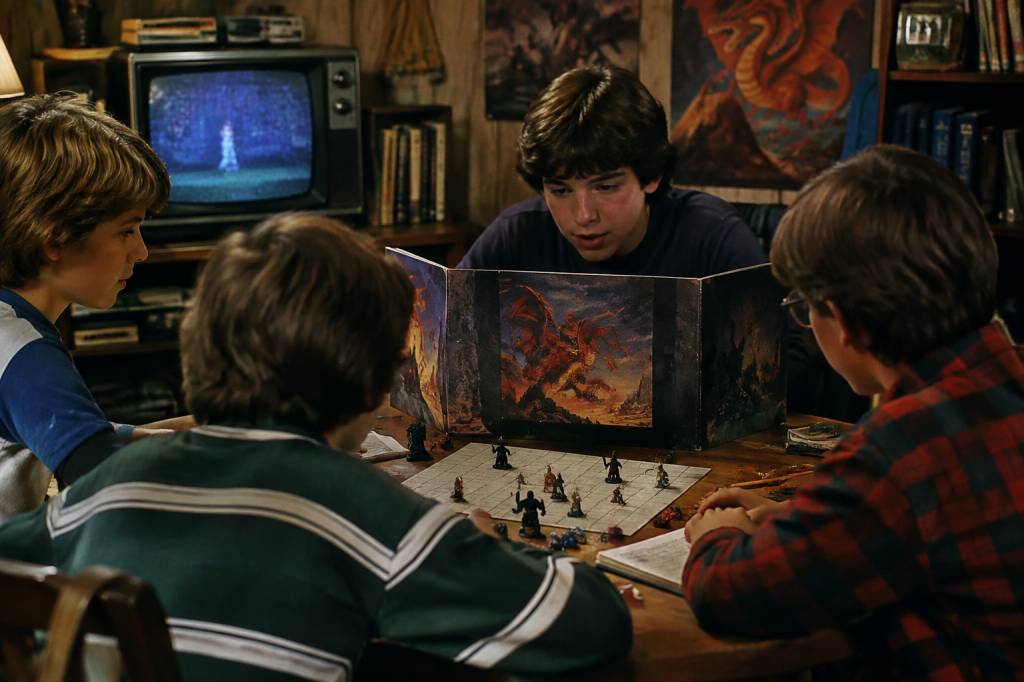
Few decades have shaped fantasy culture as visibly as the 1980s. The period produced blockbuster films, bestselling novels, collectible toys, home computers, arcade games and the first wave of fantasy television aimed at a mass audience. At the center of that expansion was Dungeons & Dragons, a tabletop role-playing game that turned fantasy from something audiences mainly watched or read into something they could actively perform.
The game did not single-handedly create modern fantasy. Its designers drew from J.R.R. Tolkien, Robert E. Howard, mythology, wargaming and older adventure fiction. However, during the 1980s, D&D provided a practical system for combining those influences. Players could build characters, explore imaginary worlds, make decisions and accept consequences without following a fixed script. That structure continues to influence video games, fantasy fiction, film, television and online communities.
Why the 1980s became D&D’s decisive decade
Dungeons & Dragons was first published in 1974 by Tactical Studies Rules, commonly known as TSR. Its early audience was concentrated among wargamers and hobbyists. The rules were dense, the books were distributed through specialist channels, and the concept was unfamiliar to the wider public.
The situation changed during the late 1970s and early 1980s. TSR expanded the game’s product range, improved its presentation and reached readers through bookstores, toy stores and comic shops. The Basic Set, particularly the editions associated with editor and designer Frank Mentzer from 1983 onward, gave beginners a more accessible entry point. The familiar red box became one of the most recognizable introductions to role-playing games.
At the same time, several cultural conditions worked in D&D’s favor:
-
Fantasy was becoming more commercially visible. Films such as Star Wars, Excalibur and Clash of the Titans demonstrated that audiences would support large-scale speculative worlds.
-
Teenagers were forming organized hobby communities. School clubs, gaming stores and conventions gave players places to meet and exchange ideas.
-
Home computing was expanding. Early computer games began translating role-playing concepts into digital formats.
-
Publishers recognized the value of connected products. Rulebooks, adventure modules, novels, toys and cartoons could reinforce one another.
D&D therefore became more than a game. It became a cultural platform. A player could encounter the brand through a red box, a paperback novel, a cartoon episode, a toy aisle or a friend’s basement campaign. That level of repetition mattered. It made the language of fantasy increasingly familiar even to people who had never rolled a twenty-sided die.
A new model for participating in fantasy
Traditional fantasy media generally positioned the audience as an observer. A novel presented a completed story. A film controlled the characters, camera and outcome. D&D changed the relationship between audience and narrative.
In a campaign, the player might decide whether to negotiate with a hostile faction, enter a dangerous ruin or ignore the obvious quest entirely. The Dungeon Master provided the setting, rules and consequences, but the story developed through group decisions. There was no guaranteed path to a final scene. Characters could succeed, fail, betray one another or die unexpectedly.
This format introduced several ideas that later became standard in fantasy entertainment:
-
Party-based storytelling: A group of characters with different abilities must cooperate despite conflicting personalities.
-
Character progression: Heroes gain experience, new powers, equipment and responsibilities over time.
-
Quest structures: A central objective is divided into encounters, obstacles and optional discoveries.
-
Moral and strategic choice: Players are often rewarded not only for combat, but also for negotiation, investigation and planning.
-
World continuity: Decisions made in one session can alter the political or personal conditions of later adventures.
These principles now appear in role-playing video games, streaming series and blockbuster franchises. In the 1980s, they were still unusual enough to feel radical. The fantasy story was no longer simply something to consume. It was a shared activity, with the rules acting as a common language between participants.
The influence of fantasy novels and published settings
The decade also established a publishing model that connected tabletop play with fiction. TSR released campaign settings and adventure material that helped Dungeon Masters build coherent worlds. Greyhawk, Dragonlance, Forgotten Realms, Ravenloft and other settings each offered different combinations of geography, history, religion, politics and magic.
Dragonlance was particularly important because it was designed as a large multimedia project involving adventures and novels. The first Dragonlance novel, Dragons of Autumn Twilight by Margaret Weis and Tracy Hickman, was published in 1984. Its success helped demonstrate that a gaming property could also function as an ongoing fantasy fiction line.
The Dragonlance books used recognizable elements of a tabletop campaign: a party of adventurers, distinct character classes, recurring villains and a long quest with escalating stakes. Yet the novels were not simply transcripts of games. They adapted those structures into conventional prose, creating a bridge between role-playing culture and the wider fantasy readership.
Other settings widened the range of fantasy available to players. Ravenloft emphasized gothic horror and moral tension. The Forgotten Realms developed a broad, character-driven world associated with author R.A. Salvatore and the popular figure Drizzt Do’Urden. Dark Sun later introduced a harsher desert environment in which resources were scarce and magic had damaged the planet.
This variety was significant. D&D was not limited to one medieval European template. By the end of the decade, it could support heroic fantasy, horror, political intrigue, high adventure and darker ecological themes.
Saturday morning television and the family audience
The Dungeons & Dragons animated series premiered in 1983 and ran for three seasons, with 27 episodes broadcast through 1985. The premise was direct: a group of young people entered a fantasy world after riding a D&D-themed amusement park attraction. They received magical weapons and were guided by the Dungeon Master while searching for a way home.
The series simplified the game for a young television audience, but it preserved several important features. The protagonists formed a party with specialized roles, including a ranger, barbarian, thief, acrobat, cavalier and illusionist. Each character had a recognizable function, which helped viewers understand the logic of class-based fantasy teams.
The program also introduced D&D imagery to households that had never visited a gaming store. Its heroes, monsters and magical artifacts became part of the visual vocabulary of 1980s children’s entertainment. The show did not explain every rule, and it did not need to. A generation learned that fantasy could involve cooperative problem-solving rather than a single invincible hero.
There was also an important commercial lesson. A tabletop game could generate characters, stories and visual designs suitable for animation and merchandise. That strategy would become common in later decades, but D&D was among the early properties to demonstrate its potential.
The moral panic surrounding role-playing games
D&D’s growth also produced controversy. In the early 1980s, critics claimed that fantasy role-playing games encouraged occult practices, unhealthy escapism or dangerous behavior. Much of this concern was amplified by misunderstanding. A game involving demons, magic and fictional violence was treated by some observers as evidence of real-world risk.
The disappearance of college student James Dallas Egbert III in 1979 became a major source of public attention. Egbert had played D&D and disappeared in the steam tunnels beneath Michigan State University. The case was later shown to be more complicated than the rumors suggested, but the story inspired media coverage and the 1982 novel Mazes and Monsters by Rona Jaffe. The book was adapted into a 1982 television film starring Tom Hanks.
These events helped create a familiar stereotype: the isolated player who cannot distinguish fantasy from reality. The image was inaccurate as a description of the broader community, but it became part of the decade’s cultural debate. Parents, schools and religious groups questioned whether the game was appropriate for children.
The controversy had two opposing effects. It stigmatized some players and encouraged sensational reporting. At the same time, it made D&D impossible to ignore. The game had moved from a niche hobby into a national conversation about imagination, youth culture and the boundary between play and identity.
Modern research and practical experience present role-playing as a social activity that can involve communication, creative writing, mathematics, problem-solving and collaboration. Those benefits should not be exaggerated; a game is not automatically educational simply because it uses dice and storytelling. Still, the old panic failed to explain why millions of players found the activity engaging without losing contact with everyday life.
From tabletop rules to digital worlds
The 1980s also established the design vocabulary of the computer role-playing game. Personal computers could not reproduce the flexibility of a human Dungeon Master, but they could simulate several essential systems: character statistics, experience points, equipment, spells, maps and turn-based combat.
Games such as Wizardry, first released in 1981, and Ultima helped define the early computer RPG. Not every title was a direct D&D adaptation, but the influence was clear. Players controlled parties, explored dangerous environments and improved characters through repeated encounters.
Licensed D&D computer games followed. The Gold Box series, developed by Strategic Simulations, Inc. and launched in 1988 with Pool of Radiance, translated the Advanced Dungeons & Dragons rules into a digital format. It used statistics, classes, spells and tactical combat in ways that felt familiar to tabletop players.
The limitations of the technology shaped the genre. Computers could calculate combat outcomes quickly, but they struggled with open-ended conversation and improvisation. As a result, early computer RPGs often emphasized menus, grids and text descriptions. That was not merely a technical compromise. It created conventions that remain visible in modern games, from character sheets and loot systems to experience levels and party management.
Today’s major fantasy RPGs may feature cinematic production values and enormous open worlds, but many still rely on structures that were normalized during this period. A player accepts a quest, enters a dungeon, gathers equipment, gains experience and returns stronger. The pattern is so familiar that its tabletop origin can be easy to overlook.
Why the decade’s aesthetics remain recognizable
The visual identity of 1980s fantasy was shaped by paperback covers, fantasy art, toy design and magazine illustrations. Artists such as Larry Elmore created memorable images for D&D products, including armored heroes, dragons, spellcasters and dramatic wilderness scenes. These illustrations did more than decorate rulebooks. They showed players what an imagined campaign might look like before the game began.
The style was often colorful, muscular and highly literal. Heroes carried oversized weapons. Dragons dominated the sky. Dungeons were packed with traps, treasure and monsters. Compared with some contemporary fantasy, the imagery could appear direct or even excessive. That directness was part of its effectiveness: a single cover needed to communicate adventure in a crowded bookstore or hobby shop.
The decade also established familiar fantasy archetypes. The heavily armored fighter, mysterious wizard, stealthy thief and noble paladin became instantly readable character types. Later creators would challenge or complicate these roles, but they first had to work against a vocabulary that D&D had helped popularize.
What D&D changed in fantasy culture
The lasting impact of 1980s D&D is not limited to dragons, dungeons or medieval costumes. Its deeper influence concerns how audiences understand fictional worlds.
-
Worlds became systems. A fantasy setting could include rules, economies, factions, histories and consequences rather than functioning only as scenery.
-
Characters became customizable. Audiences could imagine not just following a hero, but building one with specific abilities, weaknesses and goals.
-
Stories became collaborative. The best moment might come from an improvised decision that no author planned in advance.
-
Fantasy became social. Clubs, conventions and gaming groups turned private reading interests into shared identities.
-
Failure became part of entertainment. A lost battle or dead character could produce a memorable story rather than simply ending the experience.
These changes explain why D&D remains relevant even as technology has transformed entertainment. The game’s central idea is flexible: people gather, accept a set of rules and create a story together. The dice provide uncertainty, but the group supplies meaning.
The 1980s legacy in current entertainment
Modern fantasy culture frequently returns to the decade for reference. Video games continue to use party structures and class systems. Streaming shows feature ensembles with complementary abilities. Fantasy novels are increasingly discussed through the language of world-building, lore and character progression. Online platforms allow players to broadcast campaigns to audiences around the world.
The recent success of Dungeons & Dragons: Honor Among Thieves, released in 2023, also showed that the property could reach mainstream audiences without abandoning its core identity. The film used party dynamics, improvisation and failure as sources of humor and character development. Its approach was more accessible than a rulebook, but the structure remained recognizable to players.
The game’s renewed visibility does not mean every modern fantasy work is directly copying D&D. Influence is often indirect. A writer may borrow the rhythm of a quest, a designer may use a familiar character class, and a filmmaker may build an ensemble around contrasting abilities. The audience may recognize the pattern without knowing where it became standardized.
Three useful takeaways from the decade
First, the 1980s transformed D&D from a specialist wargaming experiment into a broad cultural brand. Publishing, television, novels and computer games all played a role.
Second, the game changed fantasy from a fixed narrative into a participatory format. Players did not merely identify with heroes; they made decisions as heroes and accepted unpredictable outcomes.
Third, its influence survives because the underlying design is adaptable. A tabletop campaign, a computer RPG, a streaming series and a blockbuster film can use similar ideas while offering very different experiences.
The decade still shapes fantasy culture because it established a durable formula: build a world, gather a party, create meaningful choices and allow the story to develop through consequences. The dragons remain visually important, but the real legacy is the invitation to take part.