Audio technica earbuds review for us commuters and cinephiles who crave cinematic sound on the go
Audio technica earbuds review for us commuters and cinephiles who crave cinematic sound on the go
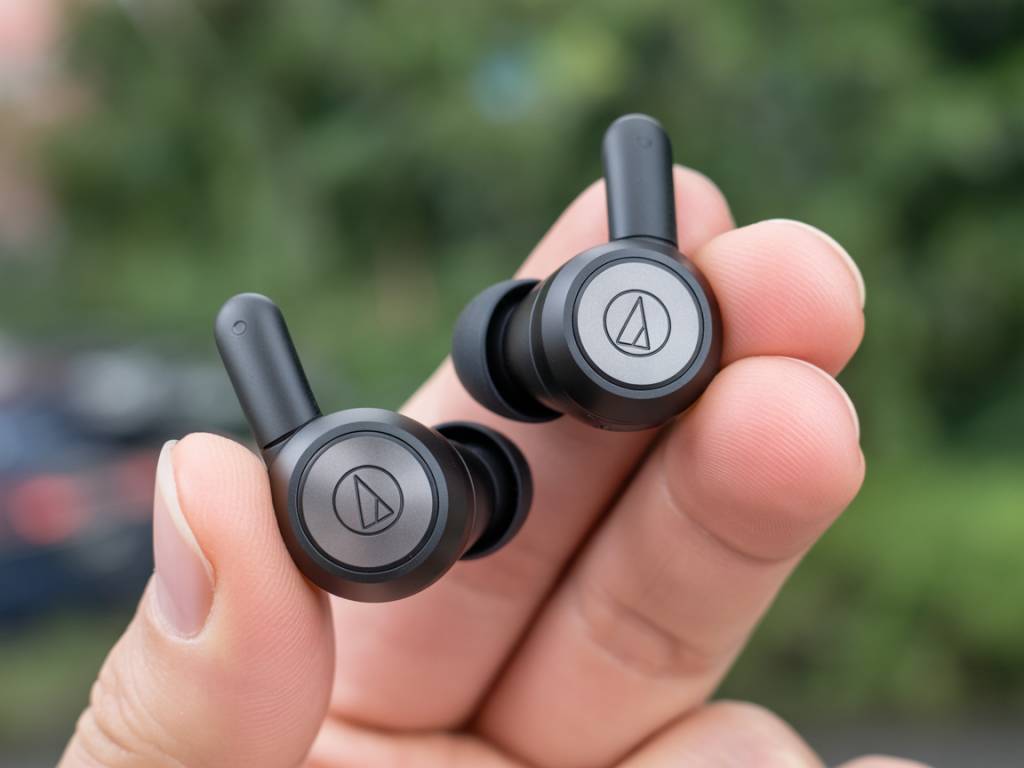
Audio-Technica has a reputation among studio engineers and vinyl lovers, not necessarily among people stuck in traffic on I-405 or binge-watching on the Amtrak Northeast Regional. Yet over the last few years, the Japanese brand has quietly built a lineup of true wireless earbuds that target a different audience: listeners who want something close to a “mini home theater” in their ears, without sacrificing practicality for daily commuting.
This article focuses on what matters specifically to U.S. commuters and movie/series addicts on the go: comfort over long stretches, isolation in noisy environments, lip-sync accuracy when streaming, and a sound profile that does justice to dialogue, soundtracks and effects.
Main models to consider in 2024
Audio-Technica’s catalog is broad, but if you are choosing with trains, buses, planes and Netflix in mind, four models stand out:
- ATH-TWX9: flagship with adaptive ANC and an unusual UV light charging case.
- ATH-TWX7: slightly more affordable, newer, with a compact design and solid ANC.
- ATH-CKS50TW: older but still relevant, with huge battery life and strong bass.
- ATH-SQ1TW: square-shaped, entry-level, no ANC but lightweight and easy to wear.
All four support at least SBC and AAC. The TWX7 and TWX9 go further with higher-quality codecs, including LDAC on compatible Android devices, which matters if you care about loss of detail in movie soundtracks.
What “cinematic” means in earbuds
“Cinematic sound” is an overused phrase in marketing, so it is useful to define it in practical terms for earbuds:
- Wide, stable soundstage: you should feel a sense of left-right separation and some front-back depth, not a flat blob of sound in the middle of your head.
- Clear dialogue: voices need to stay intelligible at reasonable volume, even when music and explosions kick in.
- Dynamic impact: action scenes should have punch; quiet scenes should have subtle ambience and detail.
- Low latency: audio should stay synced with lips, particularly for dialogue-heavy series.
With that checklist in mind, here is how the main Audio-Technica models behave in real commuting and streaming scenarios.
ATH-TWX9: the “portable cinema seat” option
The ATH-TWX9 is currently Audio-Technica’s most ambitious true wireless model. For commuters and cinephiles, three elements stand out: soundstage, ANC performance and codec support.
Sound
The TWX9 leans toward a neutral-to-warm tuning with a slight emphasis in the upper mids. That gives dialogue a clear edge without sounding too sharp. In practice:
- Voices (from news podcasts to intense courtroom dramas) stay on top of background noise and music.
- Soundtracks come through with decent layering: strings, percussion and ambient effects are distinguishable even on crowded subway rides.
- Effects in action films have weight without turning the earbud into a subwoofer. Gunshots and explosions hit, but do not blur everything else.
The soundstage is wider than average for in-ear designs. It does not mimic true surround sound, but when watching series on a tablet or phone, there is a clear lateral spread that avoids the “mono blob” effect cheaper earbuds often have.
ANC and isolation
For U.S. commuters, the TWX9’s ANC is more than a comfort feature; it directly affects how low you can keep the volume in noisy environments.
- On subway/metro: low-frequency rumbles are significantly reduced; announcements are still vaguely audible but not dominant.
- On buses: engine noise drops to a soft background, making dialogue clearer at lower volumes.
- On planes: they do not reach Bose or Sony flagship levels, but constant cabin noise is cut enough to watch two films in a row without fatigue.
Passive isolation is also decent thanks to the housing shape and provided tips, including foam-like options. Getting a good seal is crucial to keep the “cinematic” character intact.
Latency and codecs
The TWX9 supports SBC, AAC and LDAC. On recent Android phones with LDAC enabled, soundtracks retain more fine detail, particularly in high frequencies (reverb tails, ambient noise in quiet scenes).
In terms of lip-sync:
- On iOS with AAC, delay is minimal in Netflix, Disney+ and YouTube apps; speech sync is accurate enough for drama and comedy.
- On Android with LDAC, latency can be a bit higher, but most major streaming apps compensate effectively. Rare desync issues usually appear in games, not films.
Battery life and comfort
Battery is around 6 hours with ANC on (more at lower volume, without LDAC), plus additional charges from the case. In concrete terms, that covers:
- One cross-borough commute + a full two-hour film in the evening, without needing the case.
- Most medium-haul flights with at least one recharge during an airport layover.
Comfort is good for medium-sized ears; smaller ears may feel some pressure over time. The design is more traditional “rounded” than the square SQ1TW, and the weight is acceptable for long viewing sessions.
Who should choose the TWX9? Regular commuters who also travel by plane a few times a year and want a single pair that handles Spotify on the bus and full-length films on a laptop or tablet, without stepping into ultra-luxury price segments from Bose or Sony.
ATH-TWX7: compact and slightly more practical
The ATH-TWX7 is positioned under the TWX9 but keeps a similar philosophy: balanced sound plus effective ANC, with a slightly smaller footprint and softer price.
Sound
The sound signature is close to the TWX9 but a touch warmer in the low mids, which can give male voices more body. For cinema and series:
- Dialogue remains intelligible, though not quite as crisp as the TWX9 in noisy environments.
- The stage is a bit narrower, but still above average; stereo effects in sci-fi and action films remain satisfying.
- For music, the TWX7 can be a bit more “fun” in everyday listening, with slightly fuller bass.
ANC
Noise cancelling is strong enough for most commutes, though a half-step behind the TWX9, especially on constant low-frequency noises (metro, airplane engines). For daily use:
- In city buses and light rail, differences with the TWX9 are minor.
- On planes, frequent fliers will notice a bit more residual roar.
Battery and comfort
Battery life is similar on paper but can be marginally better in AAC mode, as it does not push the hardware to its limits. The form factor is slightly more compact, which can help for smaller ears or users who wear them for full workdays.
Best use case: U.S. commuters who value sound quality but want something more discreet and a bit cheaper than the flagship, while still enjoying real ANC for long rides and late-night streaming in bed.
ATH-CKS50TW: the long-haul specialist
The ATH-CKS50TW targets a slightly different audience: people who want two things above all—bass impact and extreme battery life. For cinephiles who like blockbusters, these earbuds have a specific appeal.
Battery benchmark
Audio-Technica advertises up to around 20 hours of use on a single charge (with ANC off) and still very competitive figures with ANC on. In practice, that means:
- Cross-country flights with two films, a few episodes of a series and some music, without touching the case.
- Several days of commuting for short rides without the stress of daily recharging.
Sound
The “CKS” line is known for elevated bass. For film and series:
- Explosions, sound effects and soundtrack drums hit hard; the low end is clearly more present than on TWX7/TWX9.
- On well-mixed content, this creates a visceral “cinema subwoofer” feeling, especially at moderate volume.
- On dialogue-heavy content, some users may find male voices slightly veiled by the extra warmth if the volume is low.
The stage is not as refined as on the TWX9; separation is acceptable but more focused in the head. If your primary use is Marvel films or big-budget action, the trade-off may be worth it.
Comfort and fit
The shells are bulkier and can pose a challenge for smaller ears, especially lying sideways against a pillow when watching in bed. For upright commuting, once sealed, they are stable and secure.
Who is it for? People who prioritize endurance over everything else and like their films and series with extra bass energy—think long-haul truckers, frequent cross-state drivers stopping at rest areas, or students doing multi-hour campus-to-home bus rides.
ATH-SQ1TW: budget-friendly daily driver
The ATH-SQ1TW is one of the most visually distinctive options, with its square-like shape and playful colors. It is also the simplest technically, particularly due to the absence of ANC.
Sound
The tuning is relatively balanced with a slight low-end lift. For streaming:
- Dialogue is understandable but can be masked by external noise, since you rely entirely on passive isolation.
- The stage is narrower than on the TWX models; still serviceable for sitcoms, YouTube essays and news streams.
- For casual background watching at home or in quieter suburban trains, they are perfectly adequate.
Practicality
The SQ1TW is light, easy to wear for hours and simple to operate. Battery life is decent but not groundbreaking by 2024 standards. The lack of ANC is the main limitation for heavy commuters in loud environments.
Best use case: occasional commuters, students on relatively quiet buses or trams, or people who mainly watch series at home but want a compact, comfortable pair for occasional trips.
ANC, transparency and real-world safety
For commuters, noise cancelling is not just about immersion; it also raises a safety question. How do these earbuds balance isolation and awareness?
- TWX9 / TWX7 both offer adjustable ANC levels and transparency modes. In transparency mode, voices and traffic noises become more audible, which is essential when crossing busy intersections or listening for station announcements.
- CKS50TW also includes ANC and a hear-through mode, though implementation is a bit less refined. Ambient sound can feel more “processed”.
- SQ1TW relies on physical isolation only; awareness depends on how deep you insert the tips and your volume choice.
For U.S. urban environments—New York, Chicago, Los Angeles—where cars, scooters and pedestrians compete for the same space, the ability to quickly toggle transparency should be considered essential, not optional.
App, EQ options and custom tuning for movies
Audio-Technica’s companion apps (on iOS and Android) allow for firmware updates, control mapping and EQ adjustments. This matters if you want to tailor the sound for cinema.
Typical EQ tweaks for a more “cinematic” sound on these earbuds:
- Slight midrange boost around 1–3 kHz to emphasize dialogue clarity, particularly on the CKS50TW where bass can dominate.
- Moderate treble lift in the 6–8 kHz region to bring out ambience and reverb in film soundtracks, without pushing sibilance.
- Controlled sub-bass on CKS50TW: a small cut below 80 Hz can balance explosions so they do not drown everything else.
For commuters who watch a lot of news clips and talk shows, a dedicated “Speech” preset (less bass, more midrange) is useful. For late-night film sessions, a “Cinema” preset with slightly wider V-shape (bass and treble up, mids stable) can create a more dramatic sense of immersion at lower volumes.
Connectivity and multi-device life
Many U.S. users alternate between a work laptop, a personal phone and occasionally a tablet or smart TV. The TWX7 and TWX9 support multipoint connectivity, allowing connection to two devices simultaneously.
In practice:
- You can watch a series on your tablet; when a call arrives on your phone, the earbuds switch automatically.
- In office commutes, this avoids constant manual reconnection between a work computer (Teams/Zoom) and your personal phone (Spotify, Netflix).
The CKS50TW and SQ1TW are more limited and usually require manual switching in Bluetooth settings, which is frustrating if you change devices several times per day.
How they compare to mainstream rivals for commuting and cinema
For context, Bose, Sony and Apple dominate the U.S. market for noise-cancelling earbuds. How do Audio-Technica’s offerings situate themselves for this specific “commute + cinema” use case?
- ANC strength: Bose and Sony flagships still win absolute ANC performance. Audio-Technica’s TWX9 and TWX7 are competitive enough for daily use, but not the quietest bubbles on the market.
- Sound neutrality: Audio-Technica typically leans more neutral than most mainstream competitors. For cinephiles who care about soundtracks and mixing accuracy, this can be an advantage over very bass-heavy rivals.
- Value: Depending on discounts, TWX7 and CKS50TW can offer strong performance per dollar, especially versus more expensive Apple or Bose options that lock some features into specific ecosystems.
For commuters who already own an Audio-Technica wired headset or turntable, staying within the brand offers a relatively consistent sound philosophy across devices.
Which Audio-Technica earbuds should you choose?
For U.S. commuters and movie/series lovers, the choice comes down to a few straightforward questions about budget, noise environment and taste.
- You commute daily in loud subways or fly regularly: the ATH-TWX9 is the most balanced option—good ANC, strong dialogue clarity, and a wide enough soundstage for convincing on-the-go cinema.
- You want something slightly cheaper but still serious for films: the ATH-TWX7 keeps most of the strengths (ANC, clear mids, decent codecs) in a more compact body and at a lower price.
- You watch mainly action-heavy content and care about battery above all: the ATH-CKS50TW delivers subwoofer-style impact and exceptional endurance, at the expense of a bit of dialogue precision and compactness.
- Your budget is limited and your environment is not extremely noisy: the ATH-SQ1TW is adequate for casual streaming and short commutes, though the absence of ANC makes them less ideal for crowded U.S. transit systems.
In short, Audio-Technica’s wireless earbuds do not chase gimmicks; they focus on reliable sound, acceptable ANC and practical features like multipoint and EQ. For commuters and cinephiles who care more about how a scene sounds than how a case looks on Instagram, that combination is often exactly what matters.