The 1837 Victoria coin: history, value, and collecting tips
The 1837 Victoria coin: history, value, and collecting tips
The phrase “1837 Victoria coin” sounds precise, but it describes a surprisingly broad group of objects. In most cases, collectors are referring to a British coin, pattern, token, or later reproduction connected with Queen Victoria’s accession. The first point to establish is simple: not every coin dated 1837 and bearing Victoria’s name was an ordinary circulation issue from the Royal Mint.
Queen Victoria came to the throne on 20 June 1837, after the death of her uncle, William IV. That timing matters. Many British coins dated 1837 were still produced under William IV’s reign, while regular Victorian coinage generally appeared from 1838 onward. A piece described casually as an “1837 Victoria coin” therefore requires careful identification before anyone can estimate its value.
Why 1837 matters in British coin history
Victoria was only 18 when she became queen. Her accession marked the beginning of a reign that lasted more than 63 years, from 1837 to 1901. It also began one of the most extensive and varied periods in British numismatics.
The Royal Mint had to manage a transition between monarchs, portraits, inscriptions, and production programmes. Coins already in preparation could not simply be redesigned overnight. Existing dies, metal blanks, and approval processes also affected what could be released.
For this reason, 1837 is best understood as a transitional date. William IV coins dated 1837 are genuine and historically important, but they are not Victorian coins merely because the date overlaps with the beginning of Victoria’s reign. The distinction is especially important for pennies, halfpennies, farthings, and silver denominations.
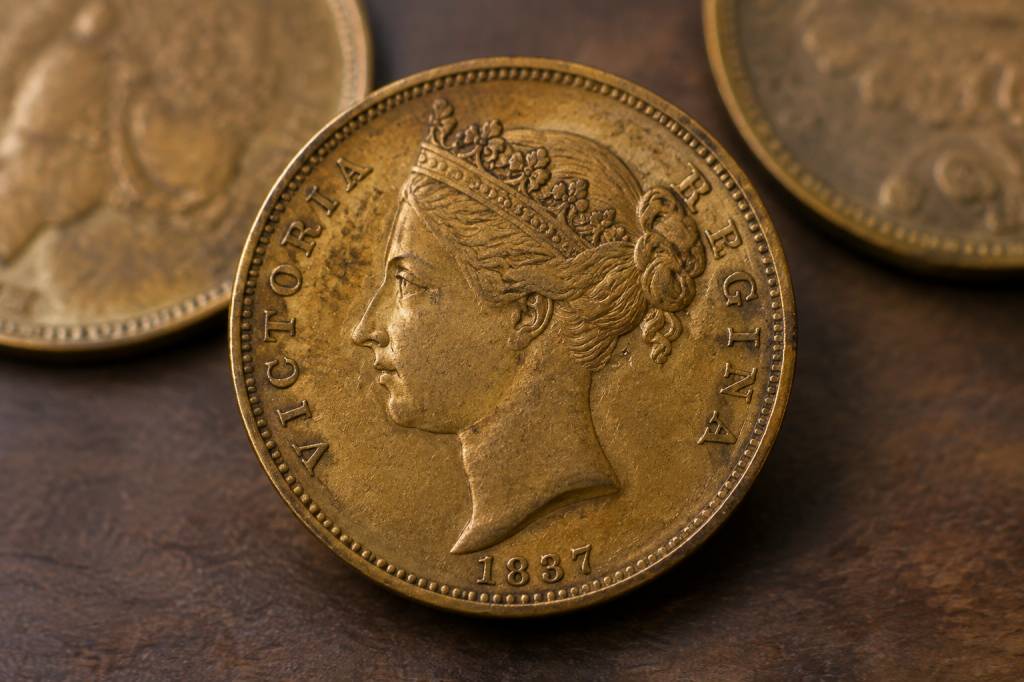
Regular British Victorian coins are more commonly encountered with dates such as 1838, 1839, or 1840. These include the famous “Young Head” portrait, which shows Victoria facing left and wearing a coronet. The image was designed by William Wyon and became one of the defining portraits of Victorian British coinage.
What might an 1837 Victoria coin actually be?
Several different categories can be confused under the same description. Before checking prices, examine the denomination, legend, portrait, metal, edge, and minting style.
- A British pattern coin: A pattern is an experimental or proposed design, not necessarily an issue intended for everyday circulation. Some 1837 pieces associated with Victoria belong to this category.
- An accession medal or token: Private manufacturers produced medals and tokens to mark Victoria’s accession. These can resemble coins but usually lack a denomination or official legal-tender status.
- A later Victorian coin: Sellers sometimes misread a worn date. A coin dated 1838 or 1839 may be advertised incorrectly as 1837, especially when the final digit is damaged.
- A colonial issue: British territories used their own coinage systems. A piece connected with Canada, Australia, or another colony may carry Victoria’s portrait but follow a different design and value structure.
- A modern reproduction: Reproductions and novelty pieces are common online. A Victorian portrait and an old-looking date do not automatically indicate a nineteenth-century minting.
There is also a practical warning for online buyers: “Victoria 1837 coin” is often used as a search phrase rather than a formal numismatic description. A listing may refer to a genuine coin, a commemorative medal, or a decorative replica. The photographs and specifications matter more than the headline.
How to identify the piece accurately
Start with the obverse, or front, of the item. Does it show Victoria, William IV, or an allegorical figure? A genuine Victorian coin normally carries a clear inscription identifying the monarch. Early Victorian British coins commonly use the legend “VICTORIA DEI GRATIA BRITANNIAE REGINA F:D,” or a related abbreviated form. The exact wording varies by denomination and period.
Next, inspect the reverse. British denominations usually display a recognizable national design. A penny may show Britannia seated beside a shield and trident. Gold sovereigns show Saint George and the dragon on many dates, although the reverse type can vary. A medal may instead feature a symbolic design, a royal cypher, a crown, or a commemorative inscription.
Measure the diameter and weigh the item using a digital scale. These two details can quickly expose a false attribution. A genuine coin should be close to the specifications recorded in established catalogues. Small differences can result from wear, corrosion, or measurement equipment, but major discrepancies are a warning sign.
- Record the exact date and all visible lettering.
- Identify the denomination, if one is stated.
- Measure diameter in millimetres.
- Weigh the piece in grams.
- Check the edge for lettering, reeding, seams, or unusual casting marks.
- Compare the portrait and lettering with authenticated examples.
- Look for a mint mark, if the type is known to use one.
The edge deserves more attention than it usually receives. Modern replicas are sometimes cast rather than struck, leaving a seam or soft, rounded lettering. Genuine nineteenth-century coins were struck with considerable pressure, producing sharper design details and more convincing metal flow. This is not a complete authentication test, but it is a useful first filter.
Patterns, medals, and circulating coins
The most interesting 1837 Victoria pieces may be patterns or trial strikes. A pattern allowed the authorities to evaluate a proposed portrait, inscription, denomination, or reverse before full production. Patterns can be rare because they were never released in large quantities, but rarity alone does not guarantee a high price. Provenance, cataloguing, condition, metal, and market demand all matter.
Accession medals occupy a different category. They were produced to commemorate Victoria becoming queen and could be made in bronze, silver, or other metals. Some were sold to the public, while others were distributed to institutions or officials. Their historical connection is strong, but they should not be described as ordinary circulating money.
This distinction affects both value and research. Searching for “1837 Victoria penny” will produce very different results from searching for “1837 Victoria accession medal” or “1837 Victoria pattern.” A collector who uses the wrong category may compare unrelated objects and reach an unrealistic price estimate.
How much is an 1837 Victoria coin worth?
There is no single market value for an “1837 Victoria coin.” The range can extend from a few dollars for a modern reproduction or common commemorative token to many thousands for a rare, authenticated pattern in strong condition. The object must be identified first.
For a genuine item, the main value factors are:
- Type and denomination: A rare pattern or prestigious gold issue generally attracts more attention than a common token.
- Condition: Sharp details, original surfaces, and limited wear usually increase value.
- Authenticity: A certified genuine piece is easier to sell and normally commands greater confidence.
- Rarity: Mintage figures, surviving population, and auction frequency are more useful than vague claims such as “very rare.”
- Metal: Gold and silver content may contribute to the price, but collector value can be much higher than bullion value.
- Provenance: A documented history, especially from a respected collection or auction, can support a significant premium.
- Eye appeal: Attractive colour, balanced toning, and clear surfaces influence buyer demand.
Price guides are useful starting points, not guarantees. Auction results provide a better picture of the current market, particularly when the comparison is based on the same variety and a similar grade. Always distinguish between an advertised asking price and a completed sale. A seller can request any figure; the market decides whether anyone pays it.
For high-value pieces, consult a recognized grading or authentication service. Certification does not make a coin valuable by itself, but it reduces uncertainty. That matters greatly when an item is rare, appears unusually sharp for its age, or is being sold for a substantial sum.
Condition: the details collectors examine
Grading early coins is not only about counting scratches. Collectors examine the highest points of the design, the lettering, the fields, and the quality of the surfaces.
On a Victorian portrait, the hair, coronet, cheek, and highest facial details often show wear first. On Britannia, inspect the helmet, folds of the clothing, shield, and trident. Weak striking can resemble circulation wear, so comparison with known examples is important.
Original colour is another consideration. Copper coins may develop brown, red-brown, or red surfaces. Bright red colour can be desirable when original, but artificially cleaned or recoloured copper is a different matter. Harsh cleaning often leaves hairlines, unnatural brightness, or a dull, damaged surface after the metal retones.
Do not polish the coin before selling it. Cleaning may remove historical surfaces and reduce collector appeal. The safest approach is usually to handle the piece by its edge, store it in an inert holder, and seek an identification before taking any action.
Common buying mistakes
The first mistake is assuming that the date alone creates rarity. Millions of nineteenth-century coins survive, and a royal portrait does not automatically indicate a valuable issue. The second is confusing a medal with a coin. If there is no denomination, no legal-tender wording, and no conventional coin design, it may be a medal or token.
A third mistake is trusting dramatic language in an online listing. Expressions such as “museum quality,” “one of a kind,” or “guaranteed rare” have little meaning without independent evidence. Ask for the weight, diameter, edge photographs, and any catalogue reference.
A fourth mistake is buying an uncertified piece because the price seems unusually low. Sometimes a bargain is genuine. More often, a low price reflects damage, a reproduction, an incorrect attribution, or a common item presented as something exceptional. The old collecting rule remains practical: if the offer seems too good to be true, slow down.
A practical checklist for collectors
- Photograph both sides in neutral light.
- Write down every visible letter and number.
- Confirm whether the monarch is Victoria or William IV.
- Search specialist catalogues using the denomination and design, not only the date.
- Compare weight, diameter, and edge details with reliable references.
- Check recent auction results for the exact type.
- Avoid cleaning, polishing, or testing with chemicals.
- Use a professional opinion before paying a high price.
The historical appeal of an 1837 Victoria piece is clear. It sits at the opening of one of Britain’s longest royal reigns and reflects a moment when the country’s coinage was moving from the William IV era into the Victorian age. But the date also creates confusion because the transition was not instantaneous.
The key points are straightforward: many 1837 British coins are still William IV issues; genuine Victoria-related pieces may be patterns, medals, tokens, or colonial coins; and value depends on exact identification, condition, authenticity, and recent market evidence. Treat the object as a historical document first and a price tag second. That approach is slower than believing an exciting online description, but it is far more likely to produce a sound collecting decision.